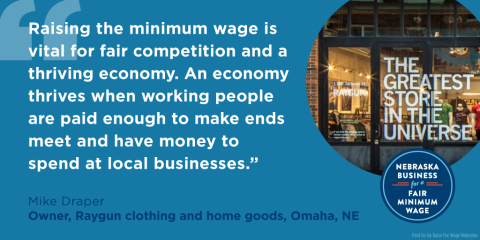
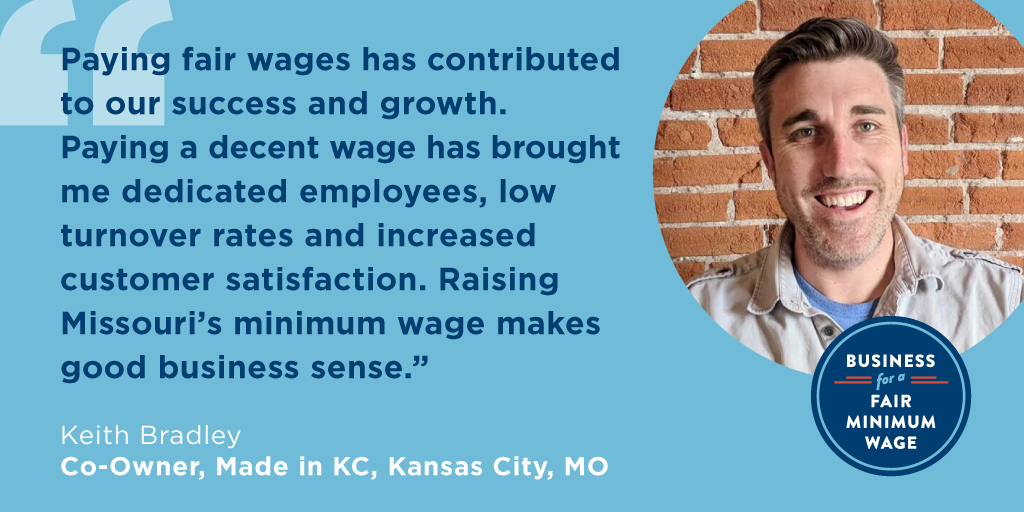
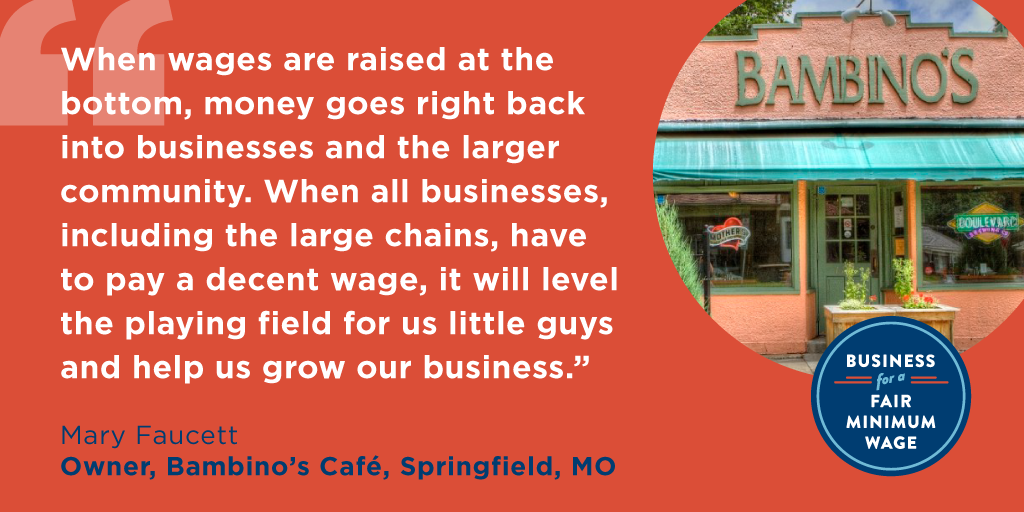
Extensive research refutes the claim that increasing the minimum wage causes increased unemployment and business closures.
Nearly 60 Maryland business organizations, owners and executives endorsed legislation to raise the state’s inadequate minimum wage to $9.75 per hour by 2013. Representing small businesses in the restaurant industry, retail, manufacturing, construction, auto repair, cleantech, healthcare, finance and more, the coalition stressed that a strong minimum wage should be a state priority because it will boost the consumer demand vital for job creation and promote a strong economy for Maryland’s future.
Inaugural signers include Illinois Main Street Alliance; National Latino Farmers and Ranchers Trade Association; Michael Shuman, Business Alliance for Local Living Economies; Bill Flynn, CEO, Paeon Partners; Amanda Kreiss, President, Inner Ecology; Peter Carey, VP, Mandel Lipton and Stevenson; Joe Pinder, Owner, Pinder Pottery; more. Click here for Signer LIST IN FORMATION.
We, the undersigned business owners and executives, support raising Illinois’s inadequate minimum wage to benefit business, workers and our economy. The Illinois minimum wage of $8.25 an hour amounts to just $17,160 for working full time, all year round.
Signers include Chesapeake Sustainable Business Alliance; Annapolis Sustainable Business Alliance; National Latino Farmers & Ranchers Trade Association; John Shepley, Co-Owner, Emory Knoll Farms; Craig Sewell, Owner, A Cook’s Cafe; Carmen Ortiz Larsen, President, Aquas Inc.; Brian England, Owner, British American Auto Care; Ida Cheinman, Founder, Substance151; Michael Vermehren, Vice President, RF Valves; Andy Shallal, Owner, Eatonville and Busboys & Poets Restaurants; more. Click for FULL LIST IN FORMATION.
By John Shepley
Carroll County Times, 3/22/11. Distributed by the American Forum.
As a small business owner, I support legislation to increase Maryland's inadequate minimum wage because it makes good business sense. It's an important part of our economic recovery and economic progress. I know businesses can pay a better minimum wage and still make a profit - it helps the business prosper.
By Lew Prince
St. Louis Post Dispatch, Feb 23, 2011
The Republicans in the Missouri Legislature are trying to overturn the clearly expressed will of the people in order to give gigantic welfare checks to some of America's biggest corporations.
Nearly 1.6 million Missourians voted to raise the minimum wage in 2006. Only 501,657 voted against the proposition. That was a 3-to-1 margin.
“A higher minimum wage makes good long term business sense. We already pay well above the current Maryland minimum wage because it’s right for our business and our people. It helps increase employee retention and productivity, which gives us a dedicated workforce that helps our business prosper. An increased minimum wage would not hurt small businesses. Rather, increasing the Maryland minimum wage will boost our regional economy by giving a much-needed raise to the many people most likely to spend it at local small businesses. - John Shepley, Co-Owner of Emory Knoll Farms Inc., Maryland
"It is but equity...that they who feed, clothe and lodge the whole body of the people, should have such a share of the produce of their own labor as to be themselves tolerably well fed, clothed and lodged."-Adam Smith, The Wealth of Nations, 1776
"Paying your employees well is not only the right thing to do but it makes for good business." -Jim Sinegal, CEO, Costco
"A minimum wage increase makes straightforward economic sense. It means more money in the hands of people who are going to spend it. Low minimum wages do NOT help small business. Small business owners know that keeping workers is easier and cheaper than finding and training new workers. And small business owners know that the longer an employee stays with you -- the more they know about your business and your customers, and the higher their productivity." -Lew Prince, Managing Partner, Vintage Vinyl, St. Louis, MO
"Solutions that depend on driving down costs by reducing wages and social benefits -- in advanced countries or in emerging economies -- are always dead ends… Strategies based on exploiting low-wage labor end up in competitive jungles, where victories are vanishingly thin and each day brings a new competitor… The activities that succeed over time are, in contrast, those that build on continuous learning and innovation."-Suzanne Berger, How We Compete: What Companies Around the World Are Doing To Make It in Today’s Global Economy (based on MIT Industrial Performance Center study of more than 500 companies)